
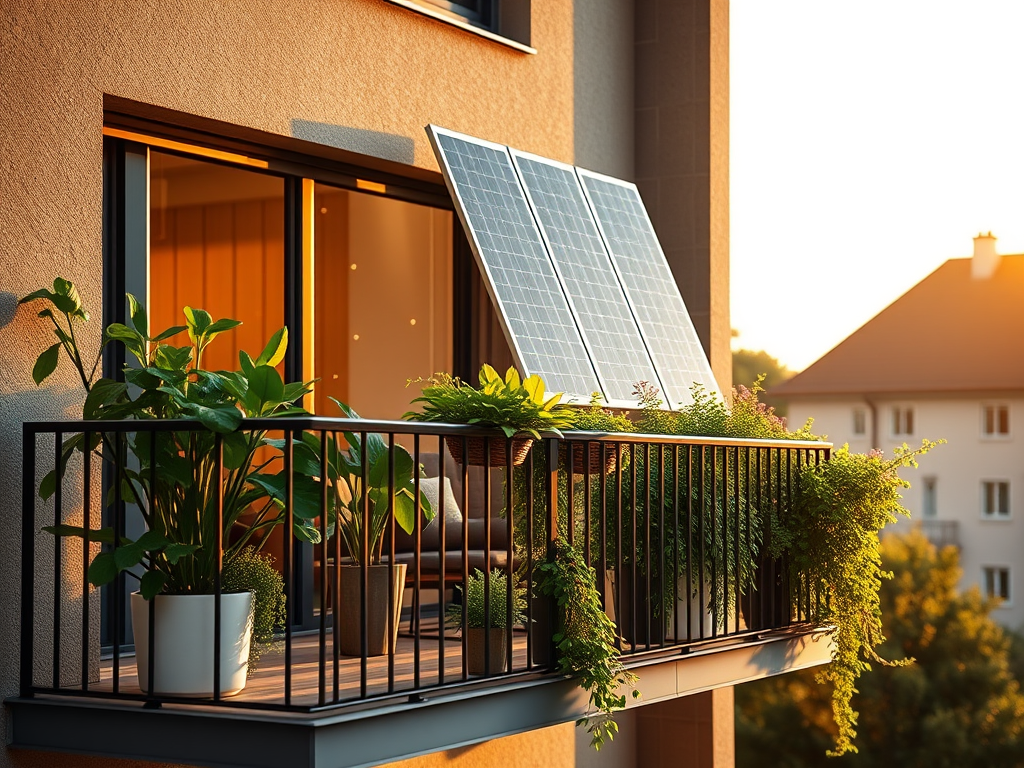
A recent article in the Guardian caught my eye on the popularity of balcony attached solar panels just recently, and given all the talk of increasing energy prices again in 2025 I thought this was a great time to look into it.
(Note: I know the main photo is an inaccurate example but I am using AI until I can find a real example to photograph!)
According to the Guardian article, 1.3 million balconies in Germany are home to a Balkonkraftwerk, literally a ‘Balcony Power Plant’. This is huge compared to the rest of Europe and is partly down to the high proportion of renting versus home-ownership in the country.
The basic premise of a Balkonkraftwerk is a low cost set of solar panels, with no installation cost, affixed to the outside of any south facing balcony and plugged into the a standard electricity socket with an adapter. There are varying estimates on the ROI but most seem to agree that the system can reduce electricity costs by up to 30% and the system can pay for itself in between 3-6 years. Sounds great, doesn’t it? So what do you need to know?
1. Understand the Legal Framework
As of 2024, new laws make it easier for tenants and property owners to install Balkonkraftwerke. Here are the key points:
- For Renters: You have the legal right to install a Balkonkraftwerk, and your landlord can only object under specific circumstances (e.g., safety or structural concerns). It’s still a good idea to inform your landlord beforehand.
- For Property Owners: If you live in a multi-unit building, you may need the approval of other property owners. However, the process has been streamlined to reduce delays.
2. Registration Requirements
To comply with German regulations, you need to register your Balkonkraftwerk in the Marktstammdatenregister (Market Master Data Register) of the Federal Network Agency. This process is straightforward and ensures that your system operates legally.
3. Technical Specifications
Make sure the system you purchase meets the following requirements:
- Maximum Output: Current regulations allow systems with an output of up to 800 watts.
- Plug-and-Play Design: The system should be compatible with standard electrical outlets.
- Safety Standards: Check for certifications to ensure the system is safe and compliant with EU standards.
4. Financial Considerations
While the initial cost of a Balkonkraftwerk ranges from €400 to €1,000, the long-term savings on electricity bills can be significant. Depending on your energy usage and location, the system may pay for itself in 3 to 6 years.
5. Optimising Efficiency
The energy output of your Balkonkraftwerk depends on factors like orientation and shading. For best results:
- Place the panels facing south.
- Avoid areas with frequent shading from trees or neighboring buildings.
- Clean the panels periodically to maintain efficiency.
But beware…
All of this sounds really tempting, and too be fair, its a great idea. But their are a few pitfalls especially for non-German speakers. The ROI sounds juicy, but the result will vary significantly if you don’t have a balcony with enough sunlight. If you are ground floor, have a small balcony facade, don’t face due south or just don’t have enough unobstructed sunlight, then this might not be for you. Then there are compliance issues with the federal network agency (Bundesnetzagentur) where I know that some people have had issues. In general though, using a reliable supplier will ensure that this isn’t an issue.
And lastly, I’ll mention your landlord again – they can’t refuse you legally, but it doesn’t mean they will agree, and is it really worth getting a lawyer involved to prove a point? We all know landlords who have been a pain in the arse, so it is worth asking in advance and winning them over beforehand.
 Living in Frankfurt
damn! Was feeling could save me some money. Not that easy as a tenant and non German speaker.
Even easy ideas are a little bureaucratic in Germany 😄